
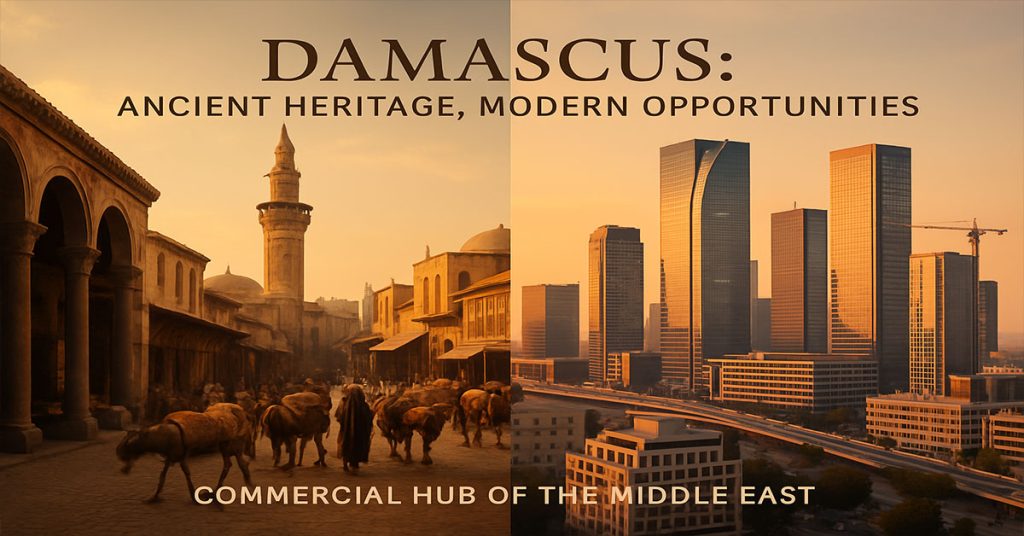
A Comprehensive Analysis for International Investors and Business Leaders
June 2025
Executive Summary
Damascus, Syria's ancient capital and one of the world's oldest continuously inhabited cities, stands at a historic inflection point. Following the dramatic political transformation in December 2024 and the comprehensive lifting of Western sanctions in May 2025, Damascus is rapidly emerging as a compelling investment destination and strategic commercial hub connecting Europe, the Middle East, and Asia.
This analysis examines Damascus's transformation from a war-torn, sanctions-isolated economy to a post-conflict reconstruction opportunity valued at up to $1 trillion in total investment needs. With the Damascus Stock Exchange reopening in June 2025, major infrastructure deals worth billions already signed, and international investors returning after more than a decade of absence, the city presents both unprecedented opportunities and significant risks for international business leaders.
The report provides actionable insights across eight critical dimensions: historical commercial significance, current economic landscape, key investment sectors, infrastructure development projects, strategic location advantages, comprehensive risk assessment, future growth projections, and specific investment recommendations. Our analysis reveals that while Damascus offers first-mover advantages in a recovering market with substantial reconstruction needs, investors must navigate complex regulatory environments, security concerns, and operational challenges inherent in post-conflict economies.

Key findings indicate that priority investment sectors include energy infrastructure ($7 billion in committed projects), real estate development (exemplified by the $3.5-7 billion Marota City project), manufacturing rehabilitation, and financial services modernization. The city's strategic position as a historical trade crossroads, combined with government incentives and international support, creates a unique window of opportunity for investors willing to accept higher risk profiles in exchange for potentially substantial returns.
1. Historical Commercial Significance
Damascus's role as a commercial hub spans over four millennia, establishing it as one of history's most enduring centers of trade and commerce. The city's strategic position at the crossroads of ancient trade routes has shaped its economic DNA and continues to influence its modern commercial potential.
Ancient Trade Routes and Commercial Heritage
Damascus emerged as a critical node in the ancient world's most important trade networks, particularly the legendary Silk Road that connected East Asia with Europe. The city's location at the eastern terminus of the easiest passage through the Anti-Lebanon mountain range made it a natural convergence point for caravans traveling between the Mediterranean coast and the interior regions of the Middle East. This geographical advantage positioned Damascus as an essential waystation where merchants from diverse cultures and regions would gather to exchange goods, ideas, and commercial practices.
The historical significance of Damascus as a trade center cannot be overstated. Archaeological evidence and historical records demonstrate that the city served as a vital link in the commercial networks that facilitated the exchange of silk, spices, precious metals, and luxury goods between the Far East and European markets. The famous Damascus steel, renowned throughout the medieval world for its superior quality and distinctive patterns, became a symbol of the city's manufacturing excellence and commercial reputation.
During the Islamic Golden Age, Damascus reached new heights of commercial prosperity. As the capital of the Umayyad Caliphate from 661 to 750 CE, the city became the political and economic center of a vast empire stretching from Spain to Central Asia. This period saw the development of sophisticated financial instruments, including early forms of banking, credit systems, and commercial law that would later influence European commercial practices. The city's merchants established trading networks that extended across three continents, creating wealth and cultural exchange that enriched Damascus's commercial traditions.
Medieval and Ottoman Commercial Development
The medieval period witnessed Damascus's evolution into a sophisticated commercial center with specialized markets, guilds, and manufacturing districts. The famous Straight Street (Via Recta), mentioned in biblical accounts, became the backbone of the city's commercial quarter, lined with shops, workshops, and trading houses that served both local and international merchants. The development of the Khan system – fortified commercial complexes that provided accommodation, storage, and trading facilities for traveling merchants – demonstrated Damascus's advanced understanding of commercial infrastructure needs.
Under Ottoman rule from 1516 to 1918, Damascus maintained its position as a major commercial hub within the empire's extensive trade networks. The Ottomans recognized the city's strategic importance and invested in infrastructure improvements, including roads, bridges, and commercial facilities that enhanced its connectivity with other major trading centers such as Istanbul, Cairo, and Baghdad. The famous Damascus souks, many of which survive today, were expanded and systematized during this period, creating one of the Middle East's most comprehensive commercial districts.
The Ottoman period also saw the development of Damascus's reputation in specific industries that would define its commercial character for centuries. The city became renowned for its textile production, particularly silk weaving and the creation of elaborate brocades that were highly prized in European courts. Damascus craftsmen also excelled in metalworking, woodcarving, and the production of luxury goods that carried the city's name across international markets.
Modern Commercial Evolution and Challenges
The 20th century brought both opportunities and challenges to Damascus's commercial development. The French Mandate period (1920-1946) introduced modern banking systems, improved transportation infrastructure, and new commercial practices that began to modernize the city's traditional trading methods. The establishment of modern financial institutions and the introduction of contemporary business practices helped Damascus adapt to changing global commercial patterns.
Following Syrian independence in 1946, Damascus experienced periods of significant commercial growth, particularly during the 1950s and 1960s when the city served as a regional hub for Arab nationalism and pan-Arab economic cooperation. The discovery and development of oil resources in eastern Syria provided new revenue streams that supported urban development and commercial expansion in Damascus.
However, the latter half of the 20th century also brought political instability and economic challenges that periodically disrupted Damascus's commercial development. The 1967 Arab-Israeli War, the 1973 oil crisis, and various regional conflicts created uncertainty that affected international trade relationships and investment flows. Despite these challenges, Damascus maintained its position as Syria's primary commercial center and continued to serve as a regional hub for trade between the Arab world and international markets.
The period from 2000 to 2010 represented a renaissance for Damascus's commercial sector. Economic liberalization policies introduced by the Syrian government opened new opportunities for private sector development and international investment. The city experienced steady economic growth averaging 4.5 percent annually, with inflation remaining below 5 percent, creating a stable environment for commercial expansion. Foreign direct investment increased significantly during this period, with international companies establishing regional headquarters and manufacturing facilities in and around Damascus.
Commercial Infrastructure and Institutional Development
Throughout its history, Damascus has demonstrated a remarkable ability to adapt its commercial infrastructure to changing needs and technologies. The city's traditional souks evolved from simple marketplaces into sophisticated commercial districts with specialized sectors for different types of goods and services. The development of modern banking, insurance, and financial services sectors during the 20th century provided the institutional foundation necessary for contemporary commercial operations.
The establishment of the Damascus Stock Exchange in 2009 marked a significant milestone in the city's financial development, providing a platform for capital formation and investment that connected Syrian businesses with regional and international financial markets. Although the exchange faced significant challenges during the conflict period, its recent reopening in June 2025 signals a return to normal commercial operations and renewed confidence in Damascus's economic future.
Damascus's commercial heritage extends beyond mere trade facilitation to encompass a sophisticated understanding of international business relationships, cultural sensitivity in commercial dealings, and the development of trust-based trading networks that have proven remarkably resilient over time. These intangible assets represent a significant competitive advantage as the city seeks to reestablish itself as a major commercial hub in the post-conflict era.
The historical precedent of Damascus as a successful commercial center provides important insights for contemporary investors and business leaders. The city's ability to serve as a bridge between different cultures, its strategic geographic position, and its deep commercial traditions create a foundation upon which modern economic development can build. Understanding this historical context is essential for appreciating both the opportunities and challenges that Damascus presents in its current transformation phase.
2. Current Economic Landscape Post-Sanctions
The lifting of comprehensive Western sanctions in May 2025 has fundamentally transformed Damascus's economic landscape, creating unprecedented opportunities while revealing the scale of reconstruction challenges ahead. This section examines the current state of the Syrian economy, the immediate impacts of sanctions relief, and the emerging investment environment that is reshaping Damascus's commercial prospects.
The Sanctions Lifting Watershed Moment
The coordinated decision by the United States, United Kingdom, and European Union to lift economic sanctions on Syria in May 2025 represents one of the most significant geopolitical and economic developments in the Middle East in recent years. President Trump's dramatic announcement on May 13, 2025, that he would order the cessation of US sanctions opened the door for comprehensive sanctions relief that had been unthinkable just months earlier.
The US Treasury's Office of Foreign Assets Control (OFAC) issued General License No. 25 (GL 25) on May 23, 2025, effectively lifting most sanctions on Syria and authorizing a broad range of previously prohibited transactions. This license permits transactions with the new Syrian government, delists 28 individuals and entities from sanctions lists, and allows new investment in Syria, imports of petroleum products, and banking relationships with Syrian financial institutions. The scope of this relief extends far beyond previous limited humanitarian exceptions, signaling a fundamental shift in US policy toward Syria's post-Assad government.
The European Union's approach proved even more comprehensive, with the Council of the European Union announcing the lifting of all economic sanctions on Syria in late May 2025. This decision, coupled with the European Commission's announcement of a €175 million aid package for Syria's social and economic recovery, demonstrates the EU's commitment to supporting Syria's democratic transition and economic reconstruction. The UK's selective approach, while more cautious, still resulted in significant sanctions relief, including the lifting of restrictions on 12 Syrian entities and easing of financial services and energy sector limitations.12.
Immediate Economic Impacts and Market Response
The market response to sanctions lifting has been swift and substantial. The Damascus Stock Exchange, which had been closed for six months during the chaotic period surrounding Assad's ouster, reopened on June 2, 2025, with Syrian Finance Minister Mohammed Yisr Barnieh declaring that the exchange would "operate as a private company and serve as a genuine hub for Syria's economic development, with a strong focus on digital". The reopening ceremony, attended by government officials and business leaders, symbolized Syria's return to normal economic operations and its integration into international financial markets.2.
International investment commitments have exceeded expectations in the immediate post-sanctions period. Major deals announced within weeks of sanctions lifting include a $7 billion energy infrastructure agreement led by Qatar's UCC Concession Investments, involving Power International USA and Turkey's Kalyon GES Enerji Yatirimlari and Cengiz Enerji. This consortium will develop four combined-cycle gas turbines with approximately 4,000 megawatts of generating capacity and a 1,000-megawatt solar power plant, representing the largest foreign investment in Syria's energy sector in over a decade.
Additional significant commitments include a $6.5 billion aid pledge from international donors and an $800 million port development agreement with Dubai-based DP World. These early investments demonstrate international confidence in Syria's stability and economic potential, while also highlighting the massive scale of reconstruction needs that create opportunities for additional investment.
Economic Baseline and Recovery Metrics
Understanding Damascus's current economic position requires examining the devastating impact of the 2011-2024 conflict period on Syria's overall economy. Before the 2011 uprising, Syria's economy was valued at $67.5 billion, ranking 68th globally and comparable to economies like Paraguay and Slovenia. The country enjoyed steady economic growth averaging 4.5 percent annually between 2000 and 2010, with inflation below 5 percent and a peak nominal GDP of $60 billion.
The conflict period resulted in catastrophic economic decline. By 2023, years of warfare and sanctions had reduced Syria's gross domestic product by 85 percent to just $9 billion, dropping the country to 129th in global rankings. This represents one of the most severe economic contractions in modern history, comparable to the economic devastation experienced by countries during major wars or economic collapses.
Current economic indicators reveal both the scale of the challenge and signs of emerging recovery. Syria's population stands at 24.7 million, with 5.6 million people living on less than $2.15 per day. Life expectancy has declined to 72.3 years, while primary school enrollment remains at 79.6 percent, indicating that basic social infrastructure has survived the conflict period better than economic infrastructure. The current GDP of $21.4 billion and GDP per capita of $869 provide a baseline from which recovery efforts can be measured.
Government Economic Policy and Reform Initiatives
The new Syrian government, led by President Ahmed al-Sharaa, has articulated an ambitious economic reform agenda focused on private sector development, international integration, and reconstruction-led growth. Finance Minister Mohammed Yisr Barnieh has emphasized that Syria represents a "land of opportunities" for investors, identifying priority sectors including farming, oil, tourism, roads, and ports. The government has already identified 20 high-priority investment opportunities with a combined potential value reaching billions of dollars. The government's economic strategy emphasizes several key principles that signal a departure from the previous regime's approach. First, there is a strong commitment to private sector leadership in economic development, with the government positioning itself as a facilitator rather than a direct participant in most commercial activities. Second, the administration has prioritized international integration, actively seeking foreign investment and technical assistance to accelerate reconstruction efforts. Third, there is recognition that economic recovery must be inclusive, addressing the needs of displaced populations and ensuring that reconstruction benefits reach all segments of Syrian society.
Institutional reforms are already underway to support this economic transformation. The government has announced plans to develop new investment laws that will provide clearer legal frameworks for foreign investors while protecting their rights and investments. Banking sector reforms are being implemented to modernize financial services and ensure compliance with international standards, including anti-money laundering and counter-terrorism financing requirements. The Damascus Stock Exchange's transformation into a private company with digital focus represents part of broader efforts to modernize Syria's financial infrastructure.
Regional and International Economic Integration
Syria's economic reintegration into regional and global markets is proceeding rapidly, with neighboring countries and international partners providing both financial support and market access opportunities. Gulf states have been particularly active in supporting Syria's economic recovery, with Qatar and Saudi Arabia paying off Syria's $15.5 million debt to the World Bank – a symbolic gesture that enables Damascus to access additional international financing. Both countries have also announced their intention to collaborate in funding Syrian public sector salaries, providing crucial support during the transition period.
The broader regional context is favorable for Syria's economic recovery. The Abraham Accords and improving relations between Israel and Arab states have created new opportunities for regional economic cooperation that could benefit Syria as it reintegrates into Middle Eastern economic networks. Turkey's continued engagement with Syria, despite previous tensions, provides important trade and investment opportunities, particularly given the two countries' shared border and historical economic ties.
International financial institutions are beginning to reengage with Syria after years of limited involvement. The International Monetary Fund conducted a staff visit to Damascus in June 2025, the first such mission in over a decade, signaling potential future cooperation in economic policy development and financial assistance. The World Bank's updated assessment of Syria's reconstruction needs, estimated at $400 billion, provides a framework for international donor coordination and investment planning.
Challenges and Constraints in the Current Environment
Despite the positive momentum generated by sanctions lifting and international support, significant challenges remain in Syria's current economic landscape. The displacement crisis continues to affect economic recovery, with 6.2 million Syrian refugees abroad and 7.2 million internally displaced persons representing a massive human capital loss. This displacement has created severe skills gaps in critical sectors such as construction and healthcare, potentially constraining reconstruction efforts.
Infrastructure deficits represent another major constraint on economic development. Years of conflict have left Syria's electricity grid, transportation networks, telecommunications systems, and water infrastructure severely damaged or destroyed. While major investment projects like the $7 billion energy deal will address some of these needs, the scale of infrastructure requirements far exceeds current investment commitments.
The security environment, while significantly improved since Assad's departure, continues to pose challenges for economic development. Sectarian tensions in some regions, ongoing conflicts with Israel, and the presence of various armed groups create uncertainty that may deter some potential investors. The new government's ability to maintain security and establish effective governance across all Syrian territory will be crucial for sustaining economic recovery momentum.
Financial sector constraints also limit the pace of economic recovery. Syria's banking system remains underdeveloped, with limited capacity to provide the credit and financial services necessary for large-scale reconstruction efforts. While international banks are beginning to reestablish relationships with Syrian financial institutions, the process of rebuilding correspondent banking relationships and ensuring compliance with international standards will take time.
The current economic landscape in Damascus and Syria more broadly represents a unique moment of transition from conflict to recovery, from isolation to integration, and from state-controlled to market-oriented economic development. Understanding this context is essential for investors and business leaders seeking to evaluate opportunities and risks in this emerging market environment.
3. Key Investment Sectors and Opportunities
Damascus's post-conflict economic transformation has created a diverse array of investment opportunities across multiple sectors, each offering distinct advantages and challenges for international investors. This comprehensive analysis examines the most promising investment sectors, their current status, growth potential, and specific opportunities available to foreign investors seeking to participate in Syria's reconstruction and economic development.
Energy Infrastructure: The Foundation of Economic Recovery
The energy sector represents the most critical and immediately investable opportunity in Damascus and Syria broadly. The $7 billion energy infrastructure deal signed in May 2025 demonstrates both the scale of need and the appetite for large-scale international investment in this sector. This landmark agreement, led by Qatar's UCC Concession Investments in partnership with Power International USA, Turkey's Kalyon GES Enerji Yatirimlari, and Cengiz Enerji, will develop a comprehensive energy generation system including 4,000 megawatts of combined-cycle gas turbine capacity and 1,000 megawatts of solar power generation.
Syria's energy infrastructure suffered devastating damage during the conflict period, with electricity generation capacity reduced by more than 70 percent from pre-war levels. The country's electrical grid, once capable of meeting domestic demand and exporting power to neighboring countries, now struggles to provide consistent electricity to major urban centers including Damascus. This infrastructure deficit creates both immediate humanitarian needs and significant economic constraints that limit industrial development and commercial activity.
Investment opportunities in the energy sector extend far beyond the initial $7 billion commitment. Renewable energy development represents a particularly attractive sub-sector, given Syria's abundant solar and wind resources and the global trend toward sustainable energy systems. The government has identified renewable energy as a priority area for foreign investment, offering incentives including tax exemptions, streamlined permitting processes, and guaranteed power purchase agreements. Solar energy projects are particularly viable in Syria's climate, with potential for both utility-scale installations and distributed generation systems that can provide energy security for industrial and commercial users.
The oil and gas sector also presents significant opportunities for international energy companies. Syria's proven oil reserves, while modest by regional standards, remain largely underdeveloped due to years of sanctions and conflict. The lifting of sanctions has reopened opportunities for international oil companies to participate in exploration, development, and production activities. Natural gas development is particularly promising, given Syria's strategic position for potential pipeline projects connecting regional gas supplies with European markets.
Energy efficiency and grid modernization represent additional investment opportunities that align with international best practices and sustainability goals. The reconstruction of Syria's electrical grid provides an opportunity to implement smart grid technologies, energy storage systems, and demand management capabilities that can improve efficiency and reliability. International companies with expertise in grid modernization and energy management systems are well-positioned to participate in these infrastructure development projects.
Real Estate and Construction: Rebuilding Syria's Urban Centers
The real estate and construction sector offers some of the most visible and immediately accessible investment opportunities in Damascus. The scale of destruction and the need for new development create a market environment with virtually unlimited demand for quality construction and real estate development projects. The Marota City project, with projected investment returns estimated between $3.5-7 billion, exemplifies the potential scale and profitability of real estate development in Damascus.
Marota City, Syria's largest investment project, encompasses a mixed-use development extending from the Kafr Soussa region to the Mezzah Eastern Villas area. The project includes luxury residences, commercial spaces, hotels, administrative buildings, and recreational facilities designed to serve as landmarks for modern Damascus. Despite controversies surrounding displacement of existing residents, the project demonstrates the government's commitment to large-scale urban redevelopment and the potential for private sector participation in city planning and development.
Commercial real estate development represents a particularly attractive opportunity given the shortage of modern office space, retail facilities, and industrial buildings in Damascus. The city's traditional commercial districts, while historically significant, lack the modern amenities and infrastructure required by contemporary businesses. International real estate developers and construction companies can capitalize on this demand by developing modern commercial complexes that meet international standards for design, sustainability, and technology integration.
Residential development opportunities are equally compelling, driven by both reconstruction needs and demographic changes. The return of displaced populations, combined with natural population growth and urbanization trends, creates substantial demand for new housing across all market segments. Affordable housing development is particularly needed, given the economic challenges facing many Syrian families, while luxury residential projects can serve returning expatriates and international business professionals.
Infrastructure-related construction opportunities extend beyond buildings to include transportation, utilities, and telecommunications infrastructure. Damascus's road network, bridges, and public transportation systems require extensive reconstruction and modernization. Water and sewage treatment facilities need complete rebuilding in many areas, creating opportunities for companies specializing in municipal infrastructure development. The development of modern telecommunications infrastructure, including fiber optic networks and 5G capabilities, represents another high-priority investment area.
Manufacturing and Industrial Development
Syria's manufacturing sector, once a significant contributor to the national economy, offers substantial opportunities for both rehabilitation of existing facilities and development of new industrial capabilities. The country's industrial base was severely damaged during the conflict, with many factories destroyed or rendered inoperable due to infrastructure failures and supply chain disruptions. This destruction, while tragic, creates opportunities for modern industrial development that can incorporate contemporary technologies and production methods.
Textile and garment manufacturing represents a traditional strength of Syrian industry with significant potential for revival and expansion. Damascus and surrounding areas historically served as major centers for textile production, with particular expertise in silk weaving, cotton processing, and garment assembly. The availability of skilled workers, despite displacement challenges, combined with competitive labor costs and improving infrastructure, creates favorable conditions for textile industry investment. International apparel companies seeking to diversify their supply chains away from traditional manufacturing centers may find Syria an attractive alternative location.
Food processing and agricultural value-added manufacturing offer opportunities that align with Syria's agricultural resources and domestic market needs. The country's agricultural sector, while damaged by conflict, retains significant productive capacity in areas such as wheat, cotton, olives, and fruits. Investment in food processing facilities can serve both domestic consumption needs and export markets, particularly in neighboring countries where Syrian food products have historically been popular. Modern food processing facilities that meet international quality and safety standards can access regional and global markets that were previously closed due to sanctions.
Pharmaceutical manufacturing represents a high-value opportunity that addresses critical domestic needs while offering export potential. Syria's healthcare system requires substantial investment in medical supplies and pharmaceuticals, creating immediate market demand for local production facilities. The country's educated workforce includes many trained chemists and medical professionals who can support pharmaceutical manufacturing operations. International pharmaceutical companies may find opportunities for both contract manufacturing and joint venture arrangements that serve regional markets.
Construction materials manufacturing is essential for supporting the massive reconstruction effort underway across Syria. Cement production, steel fabrication, and building materials manufacturing all offer opportunities for investment that directly support other sectors of the economy. The scale of reconstruction needs ensures substantial domestic demand for these products, while Syria's strategic location provides access to regional markets where construction activity is also increasing.
Financial Services and Technology
The modernization of Syria's financial services sector represents both a necessity for economic development and a significant investment opportunity for international financial institutions and technology companies. The country's banking system, while functional, lacks many of the capabilities and services required for a modern economy. The recent authorization for US banks to maintain correspondent relationships with the Commercial Bank of Syria signals the beginning of financial sector reintegration with international markets.
Digital payment systems and financial technology represent particularly promising investment areas. Syria's economy has historically relied heavily on cash transactions, creating inefficiencies and limiting the development of credit markets and electronic commerce. International fintech companies can introduce mobile payment systems, digital banking platforms, and electronic commerce capabilities that can accelerate economic development while generating substantial returns. The government's emphasis on digital transformation in the Damascus Stock Exchange's operations indicates official support for financial technology adoption.
Banking and credit services development offers opportunities for both international banks and specialized financial institutions. The reconstruction effort requires substantial credit facilities for businesses and individuals, while the lack of developed credit markets creates opportunities for institutions that can assess and manage credit risk in the Syrian context. Microfinance and small business lending represent particularly important segments that can support entrepreneurship and small-scale economic development.
Insurance services represent another underdeveloped sector with significant growth potential. The reconstruction effort creates substantial demand for construction insurance, property insurance, and business interruption coverage. International insurance companies with experience in post-conflict environments may find opportunities to establish operations in Syria while serving both domestic and international clients operating in the market.
Investment banking and capital markets development will be essential for supporting larger-scale economic development projects. The Damascus Stock Exchange's reopening creates opportunities for investment banks to provide underwriting, advisory, and trading services. Private equity and venture capital firms may find opportunities to invest in Syrian businesses and support their growth and development.
Healthcare and Education Services
The healthcare sector offers compelling investment opportunities driven by both immediate needs and long-term demographic trends. Syria's healthcare infrastructure was severely damaged during the conflict, with many hospitals and clinics destroyed or rendered inoperable. The reconstruction of healthcare facilities creates opportunities for international healthcare companies, medical equipment manufacturers, and healthcare service providers.
Private healthcare development represents a particularly attractive opportunity given the limitations of public healthcare systems and the growing demand for quality medical services. International hospital chains and healthcare providers can establish facilities in Damascus that serve both domestic patients and medical tourists from neighboring countries. Specialized medical services, including cardiac care, oncology, and advanced surgical procedures, are particularly needed and can command premium pricing.
Medical equipment and pharmaceutical distribution offer additional opportunities in the healthcare sector. The reconstruction of hospitals and clinics creates substantial demand for medical equipment, while the resumption of normal healthcare operations requires reliable supplies of pharmaceuticals and medical supplies. International companies with expertise in healthcare supply chain management can establish distribution networks that serve the Syrian market and potentially expand to neighboring countries.
Education services and educational technology represent long-term investment opportunities that align with Syria's development needs and human capital priorities. The country's education system, while maintaining relatively high enrollment rates, requires substantial investment in infrastructure, technology, and curriculum development. International education companies can provide services ranging from school construction and equipment to teacher training and educational technology platforms. Higher education and vocational training represent particularly important investment areas given the skills gaps created by displacement and the need for workforce development to support reconstruction efforts. International universities and training institutions can establish partnerships with Syrian institutions or develop independent programs that address specific skill needs in sectors such as construction, healthcare, and technology.
The diversity and scale of investment opportunities across these key sectors demonstrate the breadth of Damascus's economic transformation. Each sector offers distinct advantages and challenges, requiring careful analysis of market conditions, regulatory environments, and competitive dynamics. The interconnected nature of these sectors also creates opportunities for integrated investment strategies that can capture value across multiple areas of the economy.
Infrastructure Development Projects
Damascus's infrastructure development represents the backbone of Syria's economic reconstruction, with projects spanning transportation, utilities, telecommunications, and urban development. These infrastructure investments are essential for supporting economic growth across all sectors and creating the foundation for long-term prosperity. This section examines major infrastructure projects currently underway or planned, their investment requirements, and opportunities for international participation.
Transportation Infrastructure Modernization
Syria's transportation infrastructure suffered extensive damage during the conflict period, with roads, bridges, airports, and rail systems requiring comprehensive reconstruction and modernization. The strategic importance of Damascus as a regional transportation hub makes infrastructure investment in this sector particularly critical for the city's economic future and its role as a commercial gateway between Europe, the Middle East, and Asia.
The highway and road network connecting Damascus to other major Syrian cities and neighboring countries represents a priority area for infrastructure investment. The M5 Highway, which connects Damascus to Aleppo and serves as a critical north-south transportation corridor, requires extensive reconstruction and upgrading to handle increased commercial traffic. International construction companies and infrastructure developers can participate in these projects through public-private partnerships, build-operate-transfer arrangements, or direct government contracts.
Damascus International Airport presents significant opportunities for infrastructure investment and modernization. The airport, which served as Syria's primary international gateway before the conflict, requires substantial upgrades to terminals, runways, and support facilities to accommodate increased passenger and cargo traffic. The resumption of international flights and the expected growth in business travel and tourism create strong economic justification for airport infrastructure investment. International airport operators and aviation infrastructure companies can provide expertise and capital for these modernization efforts.
Rail transportation development offers long-term strategic opportunities that align with regional connectivity initiatives. Syria's rail network, which historically connected Damascus to major cities across the region, requires complete reconstruction in many areas. The potential for high-speed rail connections to neighboring countries and the development of freight rail capabilities for industrial and commercial use create opportunities for international rail infrastructure companies. The integration of Syrian rail networks with broader regional transportation initiatives, including potential connections to Gulf states and European markets, enhances the strategic value of these investments.
Port development and logistics infrastructure represent critical components of Damascus's role as a regional commercial hub. While Damascus is not a coastal city, its connections to Syrian ports and the development of dry port facilities for inland cargo handling are essential for supporting international trade. The $800 million port development agreement with Dubai-based DP World demonstrates international confidence in Syria's logistics potential and creates opportunities for additional investment in port and logistics infrastructure.
Energy and Utilities Infrastructure
The energy infrastructure sector, as discussed in the previous section, represents the largest single category of infrastructure investment in Syria. Beyond the major $7 billion energy generation project, numerous additional opportunities exist for investment in transmission and distribution infrastructure, energy storage systems, and grid modernization technologies.
Electrical grid reconstruction and modernization present opportunities for companies specializing in power transmission and distribution systems. The integration of new generation capacity with existing grid infrastructure requires sophisticated engineering and substantial investment in transmission lines, substations, and distribution networks. Smart grid technologies and energy management systems can improve efficiency and reliability while reducing operational costs. International companies with expertise in grid modernization can participate in these projects while introducing advanced technologies that position Syria's electrical system for future growth.
Water and wastewater infrastructure development represents another critical area requiring substantial investment. Damascus's water supply and treatment systems were severely damaged during the conflict, creating both immediate humanitarian needs and long-term economic constraints. The reconstruction of water treatment facilities, distribution networks, and wastewater treatment systems requires specialized expertise and significant capital investment. International water infrastructure companies can provide both technology and financing for these essential projects.
Renewable energy infrastructure development aligns with global sustainability trends while addressing Syria's energy security needs. Solar power installations, wind energy projects, and energy storage systems can provide clean, reliable power while reducing dependence on fossil fuel imports. The government's commitment to renewable energy development creates opportunities for international renewable energy companies to establish operations in Syria and serve both domestic and regional markets.
Telecommunications and Digital Infrastructure
The development of modern telecommunications infrastructure is essential for supporting economic growth and integrating Syria into global digital networks. The country's telecommunications systems require comprehensive upgrading to support modern business operations, e-commerce, and digital government services.
Fiber optic network development represents a fundamental requirement for modern telecommunications capabilities. The installation of high-speed internet infrastructure throughout Damascus and connecting to international networks will enable businesses to participate in global markets and support the development of technology-based industries. International telecommunications companies can invest in fiber optic infrastructure while establishing long-term service relationships with business and residential customers.
Mobile telecommunications infrastructure requires substantial investment to provide comprehensive coverage and support advanced services including 5G capabilities. The reconstruction of cellular tower networks and the introduction of modern mobile technologies can support economic development while generating substantial returns for telecommunications investors. The integration of mobile payment systems and digital services can accelerate financial inclusion and support small business development.
Data center and cloud computing infrastructure development offers opportunities for technology companies seeking to serve regional markets. The establishment of modern data centers in Damascus can support both domestic digital transformation and serve as a regional hub for cloud computing services. International technology companies can establish data center operations while providing cloud services to businesses throughout the region.
Urban Development and Smart City Initiatives
Damascus's urban development projects represent opportunities to create modern, sustainable urban environments that can attract businesses and residents while preserving the city's historical character. The integration of smart city technologies and sustainable development practices can position Damascus as a model for urban development in the region.
The Marota City project, while controversial due to displacement issues, demonstrates the scale and ambition of urban development initiatives in Damascus. This $3.5-7 billion mixed-use development includes residential, commercial, and recreational facilities designed to serve as a modern urban center. International urban planning firms, architects, and construction companies can participate in this and similar projects while introducing best practices in sustainable urban development.
Smart city technology implementation offers opportunities for technology companies to provide integrated solutions for urban management, transportation, and public services. Traffic management systems, environmental monitoring, and digital government services can improve quality of life while creating new business opportunities. The integration of Internet of Things (IoT) technologies and data analytics can optimize city operations while providing valuable insights for urban planning and development.
Green building and sustainable development initiatives align with international environmental standards while reducing long-term operational costs. The incorporation of energy-efficient building designs, renewable energy systems, and sustainable materials can create healthier urban environments while demonstrating Syria's commitment to environmental responsibility. International companies specializing in green building technologies and sustainable development can establish market leadership while contributing to Syria's environmental goals.
Industrial Infrastructure and Special Economic Zones
The development of industrial infrastructure and special economic zones represents a strategic approach to attracting manufacturing investment and creating employment opportunities. These projects can provide modern facilities and streamlined regulatory environments that encourage both domestic and international industrial development.
Industrial park development offers opportunities for real estate developers and industrial infrastructure specialists to create modern manufacturing facilities. The establishment of industrial parks with reliable utilities, transportation access, and support services can attract manufacturing companies while generating returns for infrastructure investors. The integration of environmental protection measures and sustainable practices can ensure that industrial development aligns with international standards.
Free trade zone development can provide special regulatory and tax environments that encourage international trade and manufacturing for export markets. The establishment of free trade zones near Damascus can take advantage of the city's strategic location while providing streamlined procedures for international businesses. International companies with experience in free trade zone development and management can provide expertise while establishing long-term revenue streams.
Technology parks and innovation centers can support the development of knowledge-based industries while attracting international technology companies. The establishment of facilities that support research and development, technology transfer, and startup development can diversify Syria's economy while creating high-value employment opportunities. International technology companies and venture capital firms can participate in these developments while accessing emerging markets and talent pools.
Financing and Implementation Mechanisms
The scale of infrastructure investment required in Damascus and Syria broadly necessitates innovative financing mechanisms and international cooperation. Public-private partnerships (PPPs) offer opportunities for private sector participation in infrastructure development while sharing risks and returns with government entities. International development finance institutions, including the World Bank, regional development banks, and bilateral development agencies, can provide both financing and technical assistance for infrastructure projects.
Build-operate-transfer (BOT) arrangements allow private companies to finance, construct, and operate infrastructure facilities for specified periods before transferring ownership to government entities. These arrangements can accelerate infrastructure development while providing returns to private investors. International infrastructure companies with experience in BOT projects can apply their expertise in the Syrian context while establishing long-term revenue streams.
Multilateral financing mechanisms, including syndicated loans and international bond issues, can provide the large-scale financing required for major infrastructure projects. The participation of international financial institutions and export credit agencies can reduce financing costs while providing political risk insurance. The gradual reintegration of Syrian financial institutions into international markets will expand financing options for infrastructure development.
The infrastructure development opportunities in Damascus represent both immediate needs and long-term strategic investments that will shape the city's economic future. The scale and diversity of these projects create opportunities for companies across multiple sectors while contributing to Syria's broader economic reconstruction and development goals. Success in these infrastructure investments requires careful attention to technical requirements, regulatory compliance, and coordination with government development priorities.
5. Strategic Location Advantages

Damascus's position at the crossroads of three continents has been its defining economic characteristic throughout history, and this strategic advantage remains highly relevant in the contemporary global economy. The city's geographic location, combined with its transportation infrastructure and regional connectivity, creates unique opportunities for businesses seeking to access Middle Eastern, European, and Asian markets from a single operational base.
Geographic Position and Regional Connectivity
Damascus sits at the heart of the Levant region, positioned strategically between the Mediterranean Sea to the west, the Arabian Peninsula to the south, Turkey and Europe to the north, and Iraq and the broader Middle East to the east. This central location places the city within a day's drive of major regional markets including Beirut, Amman, Baghdad, and Ankara, while maintaining relatively short distances to major ports on the Mediterranean coast.
The city's elevation of approximately 680 meters above sea level, situated in the fertile Ghouta oasis fed by the Barada River, provides natural advantages that have sustained human settlement and commercial activity for millennia. The surrounding Anti-Lebanon mountain range creates natural transportation corridors that channel trade routes through the Damascus region, reinforcing its role as a regional hub. These geographic features continue to influence modern transportation and logistics networks, making Damascus a natural convergence point for regional commerce
Syria's borders with five countries – Turkey, Iraq, Jordan, Lebanon, and Israel – position Damascus as a potential gateway for trade between these diverse markets. The normalization of relations with neighboring countries and the gradual reopening of border crossings create opportunities for Damascus to resume its historical role as a regional trade center. The city's proximity to major regional population centers, including the 20 million people living within a 500-kilometer radius, provides access to substantial consumer markets.
Transportation Networks and Logistics Advantages
Damascus's position at the intersection of major transportation corridors provides significant advantages for businesses requiring efficient logistics and supply chain management. The M5 Highway, Syria's primary north-south transportation artery, connects Damascus to Aleppo and the Turkish border, providing access to European markets via Turkey. The M1 Highway connects Damascus to the Lebanese border and Mediterranean ports, while the M20 provides access to Jordan and the broader Arabian Peninsula.
The rehabilitation of these transportation networks, currently underway as part of Syria's reconstruction efforts, will restore Damascus's connectivity to regional markets while incorporating modern logistics capabilities. The development of modern trucking facilities, cargo handling centers, and customs processing capabilities can position Damascus as a regional logistics hub serving multiple markets. International logistics companies can establish operations in Damascus to serve clients throughout the region while taking advantage of competitive operational costs.
Rail transportation connectivity offers additional strategic advantages for bulk cargo and long-distance transportation. The historic Hejaz Railway, which connected Damascus to the Arabian Peninsula, and the northern rail connections to Turkey and Europe, provide potential for freight transportation that can complement road-based logistics. The reconstruction and modernization of rail infrastructure can create opportunities for intermodal transportation systems that combine the efficiency of rail transport with the flexibility of trucking.
Damascus International Airport's strategic location and potential for expansion create opportunities for air cargo and passenger services that can serve regional markets. The airport's position allows for efficient connections to European, Asian, and African destinations, making it a potential hub for regional air transportation. The development of cargo handling facilities and freight forwarding services can support businesses requiring rapid transportation of high-value goods.
Access to Regional Markets and Trade Corridors
The resumption of normal trade relationships with neighboring countries creates opportunities for Damascus-based businesses to access diverse regional markets with varying economic characteristics and consumer preferences. Lebanon's sophisticated financial services sector and consumer market, Jordan's stable business environment and access to Gulf markets, and Turkey's large domestic market and European connections all provide opportunities for Syrian businesses.
The potential for renewed trade with Iraq represents a particularly significant opportunity given the scale of Iraq's reconstruction needs and its substantial oil revenues. Damascus's historical role as a transit point for trade between Iraq and Mediterranean markets positions the city to benefit from increased commercial activity as regional security conditions improve. The development of specialized logistics and trading services for the Iraqi market can create substantial business opportunities for Damascus-based companies.
Access to Gulf markets through Jordan and direct connections represents another major opportunity for Damascus-based businesses. The Gulf Cooperation Council countries' substantial purchasing power and demand for diverse goods and services create opportunities for Syrian exporters and service providers. The development of trade finance and logistics services specifically designed for Gulf market access can position Damascus as a regional hub for this lucrative market segment.
European market access through Turkey and Mediterranean ports provides opportunities for Syrian businesses to participate in global value chains and export to developed markets. The European Union's lifting of economic sanctions and potential for preferential trade arrangements create favorable conditions for Syrian exporters. The development of quality assurance and certification capabilities that meet European standards can enable Syrian businesses to access these high-value markets.
Energy Transit and Pipeline Opportunities
Syria's strategic position in regional energy networks creates opportunities for participation in energy transit and pipeline projects that can generate substantial revenues while supporting regional energy security. The country's location between major energy producers in the Gulf and Iraq and energy consumers in Europe and Turkey positions it as a potential energy corridor. Natural gas pipeline projects represent particularly significant opportunities given the growing demand for natural gas in European markets and the abundance of gas resources in the Middle East. The development of pipeline infrastructure connecting regional gas supplies with European markets through Syria can create long-term revenue streams while supporting regional energy integration. International energy companies can participate in these projects while establishing strategic positions in regional energy markets.
Oil pipeline and refining opportunities also exist, particularly for serving regional markets and providing value-added petroleum products. The rehabilitation of existing refining capacity and the development of new facilities can serve both domestic consumption and export markets. The strategic location of Damascus relative to both oil production areas and consumer markets creates opportunities for petroleum product trading and distribution.
Renewable energy export potential represents a forward-looking opportunity that aligns with global energy transition trends. Syria's abundant solar and wind resources, combined with its strategic location, create potential for renewable energy exports to neighboring countries. The development of renewable energy infrastructure for export can position Syria as a leader in clean energy while generating foreign exchange revenues.
Digital Connectivity and Technology Hub Potential
Damascus's strategic location extends beyond physical transportation to include digital connectivity and technology services that can serve regional markets. The development of modern telecommunications infrastructure and data center capabilities can position the city as a regional technology hub.
The establishment of fiber optic connections to major regional markets and international internet exchanges can provide high-speed, low-latency connectivity that supports technology-based businesses and services. International technology companies can establish regional operations in Damascus to serve Middle Eastern markets while taking advantage of competitive operational costs and skilled workforce availability.
Data center and cloud computing services represent opportunities to serve regional markets from a central location with competitive costs and reliable infrastructure. The development of modern data center facilities can support both domestic digital transformation and regional technology services International cloud computing providers can establish regional presence in Damascus while serving customers throughout the Middle East.
Technology services and software development capabilities can serve regional markets while taking advantage of Syria's educated workforce and competitive labor costs. The establishment of technology development centers and business process outsourcing facilities can provide services to regional and international clients. International technology companies can establish development centers in Damascus to access skilled talent while serving regional markets.
Free Trade and Economic Zone Opportunities
The development of free trade zones and special economic zones can maximize Damascus's strategic location advantages while providing favorable regulatory and tax environments for international businesses. These zones can serve as platforms for regional trade, manufacturing for export, and services that serve multiple markets.
Free trade zone development near Damascus can take advantage of the city's transportation connectivity while providing streamlined customs procedures and tax incentives for international trade. Companies operating in these zones can serve regional markets while benefiting from simplified regulatory procedures and reduced operational costs. The integration of modern logistics and warehousing facilities can support just-in-time manufacturing and distribution strategies.
Special economic zones focused on specific industries or activities can attract targeted investment while creating clusters of related businesses. Technology parks, industrial zones, and financial services centers can each take advantage of Damascus's strategic location while providing specialized infrastructure and services. International companies can establish regional headquarters or specialized operations in these zones while accessing multiple markets from a single location.
The combination of Damascus's strategic geographic position, improving transportation infrastructure, and potential for specialized economic zones creates a compelling value proposition for businesses seeking regional market access. The city's historical role as a commercial crossroads, combined with modern infrastructure and favorable investment conditions, positions it to resume its traditional function as a bridge between diverse markets and cultures. Understanding and leveraging these strategic location advantages will be essential for businesses seeking to maximize their investment returns while contributing to Syria's economic development and regional integration.
6. Risk Assessment and Mitigation
يوفر الاستثمار في دمشق والاقتصاد السوري الأوسع فرصًا كبيرة، ولكنه ينطوي على مخاطر كبيرة تتطلب تقييمًا دقيقًا واستراتيجيات شاملة للتخفيف من آثارها لحماية الاستثمارات وتعظيم العوائد. يقدم هذا القسم تحليلًا مفصلاً لأبرز فئات المخاطر التي تواجه المستثمرين الدوليين، إلى جانب نهج عملي لإدارة هذه المخاطر والتخفيف منها.
المخاطر السياسية والإدارية
تشكل المخاطر السياسية والإدارية الفئة الأكثر أهمية بالنسبة للمستثمرين في دمشق، نظرًا لعدم الاستقرار السياسي والتحديات الإدارية الملازمة لمرحلة الانتقال السورية ما بعد النزاع. على الرغم من أن الحكومة الجديدة بقيادة الرئيس أحمد الشرا أظهرت التزامًا بالإصلاح الاقتصادي والتكامل الدولي، إلا أن استقرار النظام السياسي على المدى الطويل لا يزال غير مؤكد.
تواجه شرعية الحكومة الانتقالية وفعاليتها تحديات مستمرة من مصادر متعددة. تثير أصول الحكومة في حركة تحرير الشام (HTS)، وهي منظمة ذات روابط تاريخية مع تنظيم القاعدة، مخاوف مستمرة لدى الشركاء الدوليين حول توجهات وسياسات الحكومة على المدى الطويل. على الرغم من أن الحكومة أظهرت نهجًا عمليًا في السياسة الاقتصادية والعلاقات الدولية، إلا أن احتمالية عكس السياسات أو تغيير القيادة تخلق حالة من عدم اليقين بالنسبة للتخطيط الاستثماري طويل الأجل.
تمثل التوترات الطائفية وقضايا حقوق الأقليات عاملًا مهمًا آخر للمخاطر السياسية. أثارت حالات العنف الأخيرة ضد الأقليات العرقية والدينية مخاوف بشأن قدرة الحكومة على الحفاظ على التماسك الاجتماعي وحماية جميع المواطنين السوريين. يمكن أن تتصاعد هذه التوترات إلى نزاعات أوسع تعطل النشاط الاقتصادي وتهدد مصالح المستثمرين. يجب على المستثمرين الدوليين مراقبة التطورات الاجتماعية والسياسية بعناية مع وضع خطط طوارئ لمواجهة عدم الاستقرار المحتمل.
تخلق الديناميكيات الجيوسياسية الإقليمية مخاطر سياسية تتجاوز حدود سوريا. تخلق التوترات مع إسرائيل، بما في ذلك العمليات العسكرية المستمرة والنزاعات الإقليمية، حالة من عدم اليقين بشأن الاستقرار الإقليمي وعلاقات سوريا الدولية. يمكن أن يؤثر احتمال نشوب نزاعات إقليمية أوسع أو تغيير الدعم الدولي لحكومة سوريا بشكل كبير على بيئة الاستثمار.
تتضمن استراتيجيات التخفيف من المخاطر السياسية تنويع الاستثمارات عبر قطاعات ومناطق متعددة داخل سوريا، وإقامة علاقات قوية مع المسؤولين الحكوميين ومنظمات المجتمع المدني، وتوفير تغطية شاملة للتأمين ضد المخاطر السياسية. يجب أن يحافظ المستثمرون الدوليون على مرونة في هياكل استثماراتهم للسماح بالتعديل السريع في ظل الظروف السياسية المتغيرة.
المخاطر التنظيمية والقانونية
لا يزال الإطار القانوني والتنظيمي السوري في مرحلة انتقالية، مما يخلق حالة من عدم اليقين بشأن القواعد المنظمة للعمليات التجارية وحقوق الملكية وحماية الاستثمار. على الرغم من التزام الحكومة بتطوير قوانين استثمار جديدة وتحديث الأنظمة التنظيمية، إلا أن البيئة القانونية الحالية تفتقر إلى الوضوح والثبات الذي يتطلبه المستثمرون الدوليون عادة.
لا يزال تطوير قانون الاستثمار مستمرًا، لكن غياب الأطر القانونية الشاملة يخلق حالة من عدم اليقين بشأن حقوق المستثمرين وآليات تسوية المنازعات ومتطلبات الامتثال التنظيمي. على الرغم من تشجيع التزام الحكومة بتطوير هذه الأطر، إلا أن الجدول الزمني للتنفيذ والأحكام التفصيلية للقوانين الجديدة لا تزال غير واضحة. يجب على المستثمرين الدوليين مراقبة التطورات القانونية بعناية مع ضمان توفير هياكل استثمارهم أقصى حماية ممكنة في ظل الأطر القانونية الحالية والمتوقعة.
تمثل قضايا حقوق الملكية وحيازة الأراضي تحديًا خاصًا نظرًا للتهجير والتدمير الذي حدث خلال فترة النزاع. تثير الأسئلة حول ملكية العقارات والتعويض عن الأصول المدمرة وحقوق النازحين قضايا قانونية معقدة يمكن أن تؤثر على استثمارات العقارات والبنية التحتية. توضح الخلافات حول مشروع مدينة ماروتا فيما يتعلق بالنازحين احتمالية مواجهة تحديات قانونية تتعلق بحقوق الملكية ومشاريع التنمية.
تخلق متطلبات الامتثال التنظيمي، خاصة تلك المتعلقة بمكافحة غسل الأموال وتمويل الإرهاب، التزامات مستمرة للمستثمرين الدوليين. تتطلب متطلبات العناية الواجبة المعززة بموجب إجراءات تخفيف العقوبات الاقتصادية الدولية أنظمة امتثال متطورة ومراقبة مستمرة. يمكن أن يؤدي عدم الوفاء بهذه المتطلبات إلى فرض غرامات كبيرة وفقدان الوصول إلى الأنظمة المالية الدولية.
تتضمن استراتيجيات التخفيف من المخاطر التنظيمية والقانونية التعاون مع محامين محليين ذوي خبرة، وإجراء العناية الواجبة الشاملة بشأن حقوق الملكية والمتطلبات التنظيمية، وإنشاء هياكل استثمارية توفر أقصى حماية قانونية. يجب أن يحافظ المستثمرون الدوليون على علاقات وثيقة مع السلطات التنظيمية والمشاركة في جمعيات القطاع التي يمكن أن تقدم إرشادات حول التطورات التنظيمية.
المخاطر الأمنية والتشغيلية
على الرغم من تحسن الظروف الأمنية في دمشق بشكل كبير منذ نهاية النزاع، إلا أن المخاطر الأمنية المستمرة تؤثر على العمليات التجارية والتخطيط الاستثماري. يخلق وجود جماعات مسلحة مختلفة، واحتمال حدوث أنشطة إرهابية، والنزاعات الإقليمية تحديات أمنية تتطلب إدارة دقيقة.
لا تزال مخاطر الإرهاب والأنشطة المتطرفة مرتفعة على الرغم من جهود الحكومة لتعزيز الأمن والقضاء على الجماعات المتطرفة. يمكن أن يتطلب احتمال استهداف المنشآت المدنية، بما في ذلك المرافق التجارية والموظفين الدوليين، تخطيطًا أمنيًا شاملاً وإدارة للمخاطر. يجب على الشركات الدولية تنفيذ بروتوكولات أمنية قوية مع الحفاظ على المرونة التشغيلية وسلامة الموظفين.
زادت مخاطر الجريمة والاضطرابات المدنية في بعض المناطق بسبب الصعوبات الاقتصادية وضعف قدرات إنفاذ القانون. يمكن أن تؤثر السرقة والاختطاف وأنشطة إجرامية أخرى على العمليات التجارية مع خلق مخاطر على سلامة الموظفين الدوليين. سيكون تطوير أنظمة فعالة لإنفاذ القانون والقضاء ضروريًا لتقليل هذه المخاطر مع مرور الوقت.
تمثل أمن البنية التحتية وموثوقيتها تحديات تشغيلية مستمرة يمكن أن تؤثر على استمرارية الأعمال وعوائد الاستثمار. يمكن أن تؤثر انقطاعات الكهرباء وتعطل الاتصالات وفشل شبكات النقل بشكل كبير على العمليات التجارية. على الرغم من أن استثمارات البنية التحتية الكبرى تعالج هذه القضايا، إلا أن الجدول الزمني لتحقيق خدمات بنية تحتية موثوقة لا يزال غير مؤكد.
تتضمن استراتيجيات التخفيف من المخاطر الأمنية والتشغيلية إجراء تقييمات أمنية شاملة والتخطيط، وإنشاء إجراءات للاستجابة للطوارئ، والتنسيق مع السلطات الأمنية المحلية ومقدمي الخدمات الأمنية الدولية. يجب أن يفكر المستثمرون الدوليون أيضًا في التأمين ضد المخاطر السياسية الذي يغطي الخسائر المتعلقة بالأمن وتعطل الأعمال.
المخاطر الاقتصادية والمالية
يواجه التعافي الاقتصادي في سوريا، على الرغم من زخمه الإيجابي، تحديات كبيرة تخلق مخاطر للمستثمرين الدوليين. تخلق تقلبات العملة والتضخم والوصول المحدود إلى الخدمات المالية الدولية حالة من عدم اليقين الاقتصادي.
تمثل مخاطر العملة تحديًا كبيرًا نظرًا لتقلب الليرة السورية تاريخيًا وعدم إمكانية تحويلها بسهولة. على الرغم من جهود تثبيت الاقتصاد، إلا أن احتمالية تخفيض قيمة العملة أو فرض قيود على تحويل العملة يمكن أن تؤثر على عوائد الاستثمار والتدفقات النقدية التشغيلية. يجب على المستثمرين الدوليين النظر بعناية في استراتيجيات التحوط من مخاطر العملة وهياكل الاستثمار التي تقلل من التعرض لمخاطر العملة.
تخلق قيود النظام المصرفي تحديات للمعاملات المالية وإدارة النقد. على الرغم من أن البنوك الدولية بدأت في إعادة علاقاتها مع المؤسسات المالية السورية، إلا أن قدرة النظام المصرفي لا تزال محدودة. قد يكون الوصول إلى تمويل التجارة وخطابات الاعتماد وغيرها من الخدمات المصرفية الدولية مقيدًا أو مكلفًا. تخلق متطلبات الامتثال المعززة لعلاقات البنوك أيضًا تعقيدات تشغيلية وتكاليف إضافية.
تمثل مخاطر سيولة السوق واستراتيجيات الخروج أهمية كبيرة نظرًا للتطور المحدود لأسواق رأس المال والقيود المفروضة على الاستثمار الأجنبي. يوفر إعادة فتح بورصة دمشق بعض الفرص للسيولة، لكن السوق لا يزال صغيرًا وقليل السيولة. يجب على المستثمرين الدوليين النظر بعناية في استراتيجيات الخروج ومتطلبات السيولة عند هيكلة الاستثمارات.
تتضمن استراتيجيات التخفيف من المخاطر الاقتصادية والمالية تنويع التعرض للعملة، وإقامة علاقات مع مؤسسات مالية متعددة، وهيكلة الاستثمارات بعناية لتوفير المرونة في ظل الظروف الاقتصادية المتغيرة. يجب أن يفكر المستثمرون الدوليون أيضًا في استراتيجيات التحوط والمنتجات التأمينية التي يمكن أن تحمي من المخاطر الاقتصادية والمالية.
مخاطر العقوبات والامتثال
على الرغم من رفع العقوبات الاقتصادية الرئيسية، إلا أن متطلبات الامتثال المستمرة واحتمالية إعادة فرض العقوبات تخلق مخاطر كبيرة للمستثمرين الدوليين. يتطلب التعقيد والتطور المستمر لإجراءات تخفيف العقوبات أنظمة امتثال متطورة ومراقبة مستمرة.
لا تزال قيود العقوبات المتبقية تنطبق على أفراد وكيانات وأنشطة معينة، مما يخلق التزامات مستمرة بالامتثال للمستثمرين الدوليين. يتطلب حظر المعاملات التي تفيد روسيا وإيران وكوريا الشمالية الفحص الدقيق للشركاء التجاريين والمعاملات. كما أن استمرار تصنيف سوريا كدولة راعية للإرهاب يخلق قيودًا ومتطلبات امتثال مستمرة.
تمثل احتمالية إعادة فرض العقوبات خطرًا كبيرًا يمكن أن يؤثر بشكل كبير على عوائد الاستثمار والقدرات التشغيلية. يمكن أن تؤدي التغيرات في الظروف السياسية الدولية أو سياسات الحكومة السورية إلى إعادة فرض عقوبات تقيد العمليات التجارية بشكل كبير. يجب أن يحافظ المستثمرون الدوليون على المرونة للاستجابة للتغيرات المحتملة في العقوبات مع ضمان الامتثال المستمر للمتطلبات الحالية.
تخلق متطلبات العناية الواجبة المعززة تكاليف تشغيلية وتعقيدات مستمرة للشركات الدولية. يتطلب التحقق من أن المعاملات لا تفيد الجهات المستثناة أنظمة امتثال متطورة ومراقبة مستمرة. تعقد محدودية الرؤية في الحكومة الانتقالية والاقتصاد السوري جهود الامتثال هذه.
تتضمن استراتيجيات التخفيف من مخاطر العقوبات والامتثال إنشاء أنظمة امتثال قوية، وتدريب الموظفين بانتظام على متطلبات العقوبات، والتعاون مع محامين متخصصين في العقوبات. يجب أن يحافظ المستثمرون الدوليون على وثائق شاملة لجهود الامتثال ويضعوا إجراءات للاستجابة للتغيرات المحتملة في العقوبات.
اعتبارات المخاطر الخاصة بالقطاعات
تواجه قطاعات الاستثمار المختلفة ملفات مخاطر فريدة تتطلب تقييمًا متخصصًا واستراتيجيات تخفيف. إن فهم هذه المخاطر الخاصة بالقطاعات ضروري لتطوير استراتيجيات استثمارية وإدارة مخاطر مناسبة.
تواجه استثمارات قطاع الطاقة مخاطر خاصة تتعلق بأمن البنية التحتية، والتغيرات التنظيمية، وديناميكيات سوق الطاقة الدولية. يمكن أن تخلق احتمالية استهداف البنية التحتية للطاقة، وتغيرات سياسات تسعير الطاقة، والمنافسة من موردي الطاقة الإقليميين مخاطر مستمرة لمستثمري قطاع الطاقة. كما أن دمج أنظمة الطاقة المتجددة يخلق مخاطر تقنية وتنظيمية تتطلب خبرة متخصصة.
تواجه استثمارات العقارات والبناء مخاطر تتعلق بحقوق الملكية، وجودة البناء، وطلب السوق. تخلق القضايا القانونية المعقدة المتعلقة بملكية العقارات واحتمالية النزاعات مع النازحين مخاطر قانونية مستمرة. قد لا تلبي معايير جودة البناء والسلامة المعايير الدولية، مما يخلق مخاطر مسؤولية وتشغيلية.
تواجه استثمارات التصنيع مخاطر تتعلق باضطرابات سلسلة التوريد، وتوفر العمالة، ووصول السوق. تخلق محدودية تطور شبكات الموردين واحتمالية تعطل النقل تحديات تشغيلية. يمكن أن تؤثر النقص في المهارات واضطرابات سوق العمل على القدرات الإنتاجية والتكاليف.
تواجه استثمارات الخدمات المالية مخاطر تنظيمية وامتثال خاصة نظرًا للدور المركزي للقطاع في جهود العقوبات الاقتصادية ومكافحة غسل الأموال. تخلق الرقابة المعززة على المعاملات المالية واحتمالية التغيرات التنظيمية تحديات مستمرة للامتثال. كما أن محدودية تطور أسواق الائتمان وقدرات تقييم المخاطر تخلق مخاطر تشغيلية.
يتطلب الإدارة الفعالة للمخاطر في دمشق نهجًا شاملاً يعالج فئات متعددة من المخاطر مع الحفاظ على المرونة التشغيلية وعوائد الاستثمار. يجب على المستثمرين الدوليين تقييم تحملهم للمخاطر وتطوير استراتيجيات تخفيف مناسبة مع البقاء متيقظين للتغيرات في الظروف والمخاطر الناشئة. ستكون الإدارة الناجحة لهذه المخاطر ضرورية لتحقيق أهداف الاستثمار مع المساهمة في التنمية الاقتصادية والاستقرار في سوريا.
7. توقعات النمو المستقبلي
يعتمد المستقبل الاقتصادي لدمشق على عدة عوامل مترابطة تشمل الاستقرار السياسي، وتطوير البنية التحتية، والتكامل الدولي، والتنفيذ الناجح للإصلاحات الاقتصادية. يحلل هذا القسم سيناريوهات النمو المحتملة، ومؤشرات الأداء الرئيسية، والجدول الزمني لتحقيق معالم التنمية المختلفة التي ستشكل مسار المدينة الاقتصادي خلال العقد المقبل.
سيناريوهات التعافي الاقتصادي الأساسية
يجب أن تأخذ التوقعات الاقتصادية لدمشق وسوريا بشكل عام في الاعتبار الطبيعة غير المسبوقة لانتقال البلاد من النزاع إلى إعادة الإعمار. توفر السوابق التاريخية من اقتصادات ما بعد النزاع الأخرى بعض التوجيه، لكن الظروف الفريدة لسوريا – بما في ذلك موقعها الاستراتيجي، وسكانها المتعلمين، ومواردها الطبيعية، وحجم الدعم الدولي – تخلق ظروفًا يمكن أن تدعم التعافي المتسارع.
يتوقع السيناريو المتفائل، الذي يدعمه تحليل ESCWA-UNCTAD، تحقيق معدلات نمو للناتج المحلي الإجمالي تبلغ في المتوسط 13 بالمائة سنويًا بين 2024 و2030 في ظل ظروف مواتية. يفترض هذا السيناريو استمرار الاستقرار السياسي، والتنفيذ الناجح للإصلاحات الاقتصادية، والدعم الدولي المستمر، والاستخدام الفعال لاستثمارات إعادة الإعمار. في ظل هذه الظروف، يمكن أن يصل اقتصاد سوريا إلى 40-50 مليار دولار بحلول 2030، مما يمثل تعافيًا كبيرًا من خط الأساس الحالي البالغ 21.4 مليار دولار.
يتوقع السيناريو المعتدل معدلات نمو أكثر تحفظًا تتراوح بين 6-8 بالمائة سنويًا، مما يعكس التحديات المحتملة في التنفيذ، وعدم اليقين السياسي الدوري، وتطوير البنية التحتية التدريجي بدلاً من السريع. سيؤدي هذا السيناريو إلى اقتصاد بقيمة 30-35 مليار دولار بحلول 2030، وهو ما يمثل تحسنًا كبيرًا لكنه يتطلب فترات زمنية أطول للتعافي الكامل. يأخذ هذا السيناريو في الاعتبار احتمالية حدوث انتكاسات وتعقيدات التنمية الاقتصادية في مرحلة ما بعد النزاع.
يتناول السيناريو المتشائم إمكانية تجدد عدم الاستقرار، أو إعادة فرض العقوبات الدولية، أو الفشل في تنفيذ سياسات اقتصادية فعالة. في ظل هذه الظروف، قد يظل النمو الاقتصادي محدودًا بين 2-4 بالمائة سنويًا، مع وصول الاقتصاد إلى 25-30 مليار دولار فقط بحلول 2030. يسلط هذا السيناريو الضوء على أهمية الحفاظ على الاستقرار السياسي والدعم الدولي لتحقيق تعافٍ اقتصادي مستدام.
توقعات نمو القطاعات وجداول التنمية
من المرجح أن تشهد القطاعات الاقتصادية المختلفة معدلات نمو وجداول تطوير مختلفة بناءً على خصائصها، ومتطلبات الاستثمار، وظروف السوق. إن فهم هذه الديناميكيات القطاعية ضروري للتخطيط الاستثماري واستراتيجية التنمية الاقتصادية.
من المرجح أن يشهد قطاع الطاقة نموًا سريعًا نظرًا للاستثمارات الكبيرة التي تم التعهد بها بالفعل والأهمية الحرجة للبنية التحتية للطاقة للتنمية الاقتصادية الشاملة. سيزيد مشروع البنية التحتية للطاقة بقيمة 7 مليارات دولار بشكل كبير من قدرة التوليد وتحسين موثوقية الشبكة. يمكن أن يضع استثمارات الطاقة المتجددة الإضافية سوريا كرائدة إقليمية في مجال الطاقة النظيفة مع توليد عائدات من التصدير. يمكن تحقيق معدلات نمو في قطاع الطاقة تتراوح بين 15-20 بالمائة سنويًا نظرًا لاستثمارات المشاريع الحالية والمشاريع الإضافية قيد التطوير.
من المرجح أن يشهد قطاعا البناء والعقارات أسرع معدلات نمو على المدى القريب، مدفوعين باحتياجات إعادة الإعمار الهائلة والطلب المكبوت على المرافق الحديثة. يمكن أن يولد مشروع مدينة ماروتا وتطويرات مماثلة نشاطًا اقتصاديًا كبيرًا مع خلق فرص عمل. يمكن تحقيق معدلات نمو في قطاع البناء تتراوح بين 20-25 بالمائة سنويًا خلال فترة إعادة الإعمار الذروية، لكن هذا المعدل سينخفض مع معالجة احتياجات إعادة الإعمار.
سيعتمد تعافي قطاع التصنيع على تطوير البنية التحتية، واستعادة سلاسل التوريد، وتحسين الوصول إلى الأسواق. يمكن أن يدعم إعادة تأهيل المنشآت الصناعية الحالية وتطوير قدرات تصنيعية جديدة معدلات نمو تتراوح بين 10-15 بالمائة سنويًا. يمكن أن يضع دمج التقنيات الحديثة وأساليب الإنتاج قطاع التصنيع السوري في وضع تنافسي إقليمي ودولي.
سيكون تطوير قطاع الخدمات المالية ضروريًا لدعم النمو في القطاعات الأخرى مع خلق فرص للمؤسسات المالية المتخصصة. يمكن أن يدعم تحديث أنظمة البنوك، وتطوير أسواق رأس المال، وإدخال التقنيات المالية معدلات نمو تتراوح بين 12-18 بالمائة سنويًا. سيكون تطوير القطاع حاسمًا لتسهيل الاستثمار ودعم توسع الأعمال عبر الاقتصاد.
تأثير تطوير البنية التحتية على النمو الاقتصادي
ستكون استثمارات البني التحتية أساس النمو الاقتصادي عبر جميع القطاعات، مع تأثير التوقيت وحجم هذه الاستثمارات بشكل كبير على الأداء الاقتصادي العام. يخلق العجز الحالي في البنية التحتية تحديات وفرصًا للتنمية المتسارعة.
سيكون لتحسينات البنية التحتية للنقل تأثيرات مضاعفة عبر الاقتصاد من خلال تقليل تكاليف الخدمات اللوجستية، وتحسين الوصول إلى الأسواق، وتسهيل التجارة. يمكن أن يؤدي إعادة بناء شبكات الطرق السريعة، وتحديث مطار دمشق الدولي، وتطوير اتصالات السكك الحديدية إلى تقليل تكاليف النقل بنسبة 20-30 بالمائة مع تحسين الموثوقية. ستكون هذه التحسينات مفيدة بشكل خاص للأنشطة الصناعية والتجارية.
سيؤدي تطوير البنية التحتية للطاقة إلى إزالة القيود الحرجة على النمو الاقتصادي مع وضع سوريا لتصدير الطاقة. سيؤدي إكمال مشاريع توليد الطاقة الكبرى إلى القضاء على نقص الكهرباء الذي يحد حاليًا من الإنتاج الصناعي والنشاط التجاري. يمكن أن يزيد إمداد الكهرباء الموثوق من الإنتاجية الصناعية بنسبة 25-40 بالمائة مع تمكين الصناعات كثيفة الاستهلاك للطاقة.
سيمكن تحديث البنية التحتية للاتصالات من التحول الرقمي عبر جميع القطاعات مع دعم تطوير الصناعات القائمة على التكنولوجيا. ستكون اتصالات الإنترنت عالية السرعة وخدمات الاتصالات الحديثة ضرورية للمشاركة في سلاسل القيمة العالمية والوصول إلى الأسواق الدولية. يمكن أن تزيد هذه التحسينات من الإنتاجية عبر جميع القطاعات مع تمكين نماذج الأعمال والخدمات الجديدة.
التوقعات السكانية والديموغرافية
ستؤثر الاتجاهات الديموغرافية في سوريا بشكل كبير على إمكانات النمو الاقتصادي، مع عودة النازحين والنمو السكاني الطبيعي يخلقان فرصًا وتحديات للتنمية الاقتصادية.
ستؤثر أنماط عودة اللاجئين على عرض العمالة، والطلب الاستهلاكي، واحتياجات إعادة الإعمار. تشير التقديرات الحالية إلى عودة 300,000 لاجئ (4.9 بالمائة من الإجمالي) منذ تغيير النظام في ديسمبر 2024. يمكن أن توفر معدلات العودة المتسارعة المهارات والعمالة الأساسية لجهود إعادة الإعمار مع زيادة الطلب المحلي على السلع والخدمات. ومع ذلك، سيتطلب دمج العائدين استثمارات كبيرة في الإسكان والتعليم والخدمات الصحية.
ستؤثر تسوية النزوح الداخلي أيضًا على أنماط التنمية الاقتصادية، مع توطين النازحين داخليًا يخلق فرصًا للتنمية الإقليمية مع الحاجة إلى استثمارات في البنية التحتية. يمثل 7.2 مليون نازح داخليًا حاليًا تحديًا وفرصة للتنمية الاقتصادية. يمكن أن يدعم توطينهم التنمية الإقليمية المتوازنة مع توفير العمالة لمشاريع إعادة الإعمار.
تمثل التركيبة السكانية الشابة فرصًا وتحديات للتنمية الاقتصادية. يوفر عدد السكان الصغير نسبيًا في سوريا عائدًا ديموغرافيًا محتملاً إذا تم توفير فرص عمل وتمكنت أنظمة التعليم من تقديم المهارات ذات الصلة. ومع ذلك، أدى انقطاع التعليم خلال فترة النزاع إلى فجوات في المهارات تتطلب استثمارات مستهدفة في التعليم والتدريب.
التكامل الدولي وتطوير التجارة
سيكون إعادة دمج سوريا في الشبكات الاقتصادية الإقليمية والعالمية حاسمًا لتحقيق نمو اقتصادي مستدام والوصول إلى الأسواق الدولية. سيكون للجدول الزمني ومدى هذا التكامل تأثير كبير على توقعات النمو.
تظهر العلاقات التجارية الإقليمية بالفعل علامات التعافي، مع استئناف الدول المجاورة العلاقات التجارية وتقديم الاستثمارات والمساعدات. يمكن أن يؤدي تطبيع التجارة مع لبنان والأردن وتركيا إلى زيادة حجم التجارة بنسبة 50-100 بالمائة خلال ثلاث سنوات. يمكن أن توفر إمكانية استئناف التجارة مع العراق ودول الخليج فرص نمو إضافية.
يوفر الوصول إلى الأسواق الأوروبية من خلال رفع عقوبات الاتحاد الأوروبي فرصًا للمصدرين السوريين للوصول إلى أسواق عالية القيمة. يمكن أن يمكّن تطوير قدرات ضمان الجودة والشهادات التي تلبي المعايير الأوروبية من تحقيق نمو كبير في الصادرات. يمكن أن تجد المنتجات الزراعية والمنسوجات والسلع المصنعة السورية أسواقًا كبيرة في أوروبا إذا تم الوفاء بمعايير الجودة والموثوقية.
سيتطلب التكامل في سلاسل الإمداد العالمية تحسينات كبيرة في البنية التحتية، وأنظمة الجودة، والممارسات التجارية. يمكن للشركات السورية التي تلبي المعايير الدولية وتوفر خدمات سلسلة التوريد الموثوقة أن تحقق حصة سوقية كبيرة في الأسواق الإقليمية والعالمية. يمكن أن يجعل تطوير خدمات الخدمات اللوجستية والتجارة المتخصصة دمشق مركزًا إقليميًا للتجارة الدولية.
إمكانات تطوير التكنولوجيا والابتكار
سيكون تطوير قدرات التكنولوجيا والابتكار ضروريًا لتحقيق نمو اقتصادي مستدام والمنافسة في الأسواق العالمية. يوفر عدد السكان المتعلم في سوريا والتركيز التاريخي على التعليم أساسًا لتطوير قطاع التكنولوجيا.
يمكن أن يوفر تطوير خدمات تكنولوجيا المعلومات فرص عمل عالية القيمة مع خدمة الأسواق الإقليمية والدولية. يمكن أن يولد إنشاء مراكز تطوير البرمجيات، ومرافق الاستعانة بمصادر خارجية للعمليات التجارية، وشركات خدمات التكنولوجيا عائدات تصدير كبيرة. يمكن أن يجتذب هيكل التكاليف التنافسي وتوفر القوى العاملة الماهرة شركات التكنولوجيا الدولية الراغبة في إنشاء عمليات إقليمية.
يمكن أن يسرع تطوير التكنولوجيا المالية الشمول المالي مع توفير خدمات مبتكرة للأسواق الإقليمية. يمكن أن يدعم إدخال أنظمة الدفع عبر الهاتف المحمول، ومنصات الخدمات المصرفية الرقمية، وقدرات التجارة الإلكترونية التنمية الاقتصادية مع خلق فرص أعمال جديدة. يوفر القطاع المالي غير المتطور نسبيًا فرصًا للقفز إلى تقنيات مالية متقدمة.
يمكن أن تدعم قدرات البحث والتطوير الابتكار عبر قطاعات متعددة مع اجتذاب الشراكات الدولية. يمكن أن يوفر إعادة تأهيل الجامعات ومؤسسات البحث الأساس لنقل التكنولوجيا وتطوير الابتكار. يمكن أن تسرع الشراكات الدولية مع الجامعات ومؤسسات البحث تطوير القدرات مع الوصول إلى شبكات المعرفة العالمية.
أهداف التحول الاقتصادي طويلة الأجل
تمتد أهداف التنمية الاقتصادية طويلة الأجل لسوريا إلى ما هو أبعد من مجرد التعافي لتشمل التحول الأساسي في الهيكل الاقتصادي والقدرات. ستشكل هذه الأهداف أولويات الاستثمار واستراتيجيات التنمية خلال العقد المقبل.
سيكون التنويع الاقتصادي بعيدًا عن القطاعات التقليدية نحو أنشطة ذات قيمة مضافة ضروريًا لتحقيق نمو مستدام وقدرة تنافسية. يمكن أن يقلل تطوير قطاعات التكنولوجيا، والخدمات المالية، والصناعات القائمة على المعرفة من الاعتماد على القطاعات التقليدية مع خلق فرص عمل ذات قيمة أعلى. سيتطلب هذا التنويع استثمارات كبيرة في التعليم، والبنية التحتية، والتطوير المؤسسي.
يمكن أن يجعل التكامل الاقتصادي الإقليمي سوريا مركزًا للتجارة والخدمات والاستثمار الذي يخدم أسواقًا متعددة. يمكن أن يخلق تطوير قدرات متخصصة في الخدمات اللوجستية، والخدمات المالية، والتكنولوجيا مزايا تنافسية تمتد إلى ما هو أبعد من السوق المحلية. سيتطلب هذا التكامل استمرار تحسين البنية التحتية، والأنظمة التنظيمية، والممارسات التجارية.
سيكون تبني ممارسات التنمية المستدامة ضروريًا لضمان أن يكون النمو الاقتصادي مسؤولًا بيئيًا وشاملًا اجتماعيًا. يمكن أن يجعل دمج الطاقة المتجددة، والتنمية الحضرية المستدامة، وإجراءات حماية البيئة سوريا رائدة في التنمية المستدامة مع اجتذاب الاستثمارات الدولية. ستكون هذه الممارسات ضرورية أيضًا للوصول إلى الأسواق الدولية وتلبية المعايير العالمية.
يتطلب تحقيق توقعات النمو وأهداف التحول هذه التزامًا مستمرًا بالإصلاح الاقتصادي، والدعم الدولي المستمر، والتنفيذ الفعال لاستراتيجيات التنمية. على الرغم من أهمية التحديات، إلا أن الفرص لتحقيق نمو اقتصادي وتحول كبير متساوية في قوتها، مما يجعل دمشق وجهة جذابة للمستثمرين الراغبين في المشاركة في عملية التعافي والتنمية الاقتصادية التاريخية هذه.
8. توصيات استثمارية قابلة للتنفيذ
بناءً على التحليل الشامل لتحول دمشق الاقتصادي، يقدم هذا القسم توصيات محددة وقابلة للتنفيذ للمستثمرين الدوليين وقادة الأعمال الراغبين في الاستفادة من فرص إعادة إعمار سوريا مع إدارة المخاطر المرتبطة بها. يتم تنظيم هذه التوصيات حسب نهج الاستثمار، وتركيز القطاع، والجدول الزمني للتنفيذ لتقديم إرشادات عملية لاتخاذ قرارات الاستثمار.
استراتيجيات الاستثمار في الفرص الفورية (0-18 شهرًا)
يوفر البيئة الحالية عدة فرص استثمارية فورية يمكن أن تحقق عوائد مع وضع المستثمرين في موضع ريادي في بيئة سوق ناشئة. تتطلب هذه الفرص اتخاذ قرارات سريعة لكنها توفر ميزة المبادرة.
شراكات البنية التحتية للطاقة: يجب على شركات الطاقة الدولية استكشاف فرص الشراكة فورًا مع ائتلاف قطر الذي يقود تطوير مشروع البنية التحتية للطاقة في سوريا بقيمة 7 مليارات دولار. توجد فرص ثانوية للمقاولين المتخصصين، وموردي المعدات، ومقدمي الخدمات الداعمة لهذا المشروع الضخم. يجب على الشركات ذات الخبرة في الطاقة المتجددة، وتحديث الشبكة، وأنظمة تخزين الطاقة، إنشاء علاقات مع المسؤولين السوريين وشركاء التنمية الدوليين للاستعداد لمشاريع طاقة إضافية.
مشاريع التطوير العقاري المشتركة: يوفر مشروع مدينة ماروتا ومبادرات التطوير الحضري المماثلة فرصًا فورية لمطوري العقارات الدوليين، وشركات البناء، وشركات التخطيط الحضري. يمكن أن توفر ترتيبات المشاريع المشتركة مع الشركاء السوريين المعرفة المحلية مع تقاسم المخاطر والعوائد. يجب التركيز على العقارات التجارية، والتطويرات السكنية الحديثة، والمشاريع متعددة الاستخدامات التي تخدم المغتربين العائدين والمحترفين التجاريين الدوليين.
دخول سوق الخدمات المالية: يوفر إعادة فتح بورصة دمشق والسماح بعلاقات مصرفية دولية فرصًا فورية للمؤسسات المالية. يمكن أن تقدم بنوك الاستثمار خدمات الاكتتاب والاستشارات للشركات السورية الراغبة في جمع رأس المال، بينما يمكن للبنوك التجارية إنشاء علاقات مراسلة وقدرات تمويل التجارة. يجب على شركات التقنية المالية استكشاف فرص إدخال أنظمة الدفع عبر الهاتف المحمول ومنصات الخدمات المصرفية الرقمية التي يمكن أن تخدم الفئات غير المصرفية.
عمليات الاستيراد والتصدير: أدى رفع العقوبات إلى خلق فرص فورية لشركات التجارة لإنشاء عمليات استيراد وتصدير تخدم الأسواق السورية وتستخدم سوريا كمركز إقليمي. يجب التركيز على مواد البناء، والمعدات الصناعية، والسلع الاستهلاكية، والمنتجات الزراعية. يمكن للشركات ذات العمليات الإقليمية الحالية إنشاء شركات تابعة أو شراكات سورية بسرعة لاحتلال حصة سوقية في الأسواق المتعافية.
الاستثمارات الاستراتيجية متوسطة الأجل (18 شهرًا – 5 سنوات)
يجب أن تركز استراتيجيات الاستثمار متوسطة الأجل على بناء مواقع سوقية كبيرة مع دعم التنمية الاقتصادية الأوسع في سوريا. تتطلب هذه الاستثمارات التزامات رأسمالية أكبر لكنها توفر فرصًا لعوائد كبيرة مع تعافي الاقتصاد.
التصنيع والتنمية الصناعية: يجب على الشركات المصنعة الدولية تقييم فرص إنشاء منشآت إنتاج في سوريا لخدمة الأسواق الإقليمية. تشمل قطاعات الأولوية معالجة الأغذية، والمنسوجات، والأدوية، ومواد البناء. يخلق الجمع بين انخفاض تكاليف العمالة، وتحسين البنية التحتية، والوصول إلى الأسواق الإقليمية ظروفًا مواتية للاستثمار الصناعي. يجب على الشركات التركيز على المنشآت الحديثة والفعالة التي تلبي معايير الجودة الدولية مع خدمة الأسواق المحلية والتصديرية.
مشاريع تطوير البنية التحتية: توفر مشاريع البنية التحتية الكبرى في النقل، والمرافق، والاتصالات فرصًا لعوائد كبيرة مع دعم التنمية الاقتصادية. يمكن أن توفر ترتيبات الشراكة بين القطاعين العام والخاص تدفقات إيرادات مستقرة وطويلة الأجل مع تقاسم المخاطر مع الجهات الحكومية. يجب التركيز على إعادة بناء الطرق السريعة، وتحديث المطارات، وشبكات الاتصالات، ومرافق معالجة المياه. تتمتع شركات البنية التحتية الدولية ذات الخبرة في بيئات ما بعد النزاع بميزة خاصة لهذه الفرص.
خدمات الرعاية الصحية والتعليم: يخلق إعادة إعمار أنظمة الرعاية الصحية والتعليم في سوريا فرصًا لمقدمي الخدمات الدوليين لإنشاء عمليات مع خدمة الاحتياجات الاجتماعية الحرجة. توفر تطوير المستشفيات الخاصة، وتوزيع المعدات الطبية، وخدمات التكنولوجيا التعليمية إمكانات نمو. تتماشى هذه الاستثمارات مع أهداف التنمية الدولية مع تحقيق عوائد تجارية.
مراكز التكنولوجيا والابتكار: يمكن أن يدعم إنشاء المتنزهات التكنولوجية، ومراكز الابتكار، وحاضنات الأعمال تطوير الصناعات القائمة على المعرفة مع خلق فرص للإيرادات العقارية والخدمية. يمكن لشركات التكنولوجيا الدولية إنشاء مراكز تطوير إقليمية مع الوصول إلى المواهب السورية الماهرة بتكاليف تنافسية. يجب التركيز على تطوير البرمجيات، والاستعانة بمصادر خارجية للعمليات التجارية، وخدمات التكنولوجيا للأسواق الإقليمية.
التموضع الاستراتيجي طويل الأجل (5-10 سنوات)
يجب أن تركز استراتيجيات الاستثمار طويلة الأجل على التموضع لتحقيق التعافي الاقتصادي الكامل لسوريا ودمجها في الأسواق الإقليمية والعالمية. تتطلب هذه الاستثمارات رأسمال صبور لكنها توفر فرصًا لعوائد كبيرة مع تحقيق سوريا إمكاناتها الاقتصادية.
تطوير مركز إقليمي: يجب على الشركات وضع دمشق كمركز إقليمي لعملياتها في الشرق الأوسط، مع الاستفادة من الموقع الاستراتيجي للمدينة وتحسين البنية التحتية. يتطلب هذا النهج استثمارات كبيرة في المرافق، والموظفين، وتطوير السوق لكنه يوفر الوصول إلى أسواق إقليمية متعددة من موقع تشغيلي واحد. يجب التركيز على الخدمات اللوجستية والتوزيع، والخدمات المالية، وخدمات التكنولوجيا، وعمليات المقرات الإقليمية.
تطوير الموارد الطبيعية: توفر موارد النفط والغاز في سوريا، وإن كانت متواضعة بالمقارنة الإقليمية، فرصًا لشركات الطاقة الدولية الراغبة في الالتزام طويل الأجل. يمكن أن توفر مشاريع الاستكشاف والتطوير عوائد كبيرة مع دعم استقلالية الطاقة وإمكانات التصدير في سوريا. يمثل تطوير الطاقة المتجددة للاستخدام المحلي والتصدير الإقليمي فرصة جذابة بشكل خاص على المدى الطويل.
تطوير المجمعات الصناعية: يمكن أن يخلق إنشاء مجمعات صناعية متخصصة في قطاعات مثل المنسوجات، ومعالجة الأغذية، والتكنولوجيا مزايا تنافسية مع دعم التنمية الاقتصادية الأوسع. يمكن للشركات الدولية قيادة تطوير المجمعات مع إنشاء مواقع سوقية مهيمنة. يمكن أن تكون هذه المجمعات منصات للتوسع الإقليمي مع خلق فرص عمل وفرص تنمية اقتصادية.
تطوير الأسواق المالية: يخلق التطور طويل الأجل لأسواق رأس المال في سوريا فرصًا لبنوك الاستثمار، ومديري الأصول، والمستثمرين المؤسسيين لإنشاء مواقع قيادية في السوق. سيخلق نمو بورصة دمشق وتطوير أسواق السندات، وخدمات التأمين، وصناديق الاستثمار فرصًا كبيرة لشركات الخدمات المالية. يمكن أن يوفر الدخول المبكر إلى السوق مزايا تنافسية تستمر مع نضوج الأسواق.
توصيات إدارة المخاطر والعناية الواجبة
يتطلب الاستثمار الناجح في دمشق عمليات شاملة لإدارة المخاطر والعناية الواجبة تعالج التحديات الفريدة لبيئات الاستثمار ما بعد النزاع.
تقييم ومراقبة المخاطر السياسية: يجب على المستثمرين إنشاء أنظمة شاملة لمراقبة المخاطر السياسية تتابع استقرار الحكومة، وتغيرات السياسات، والتطورات الإقليمية. يجب أن يوجه التقييم المنتظم للظروف السياسية قرارات الاستثمار واستراتيجيات إدارة المخاطر. يجب النظر في التأمين ضد المخاطر السياسية لجميع الاستثمارات الكبيرة، مع تغطية المصادرة، والعنف السياسي، وعدم إمكانية تحويل العملة.
الامتثال القانوني والتنظيمي: يجب أن تشمل جميع الاستثمارات العناية الواجبة القانونية الشاملة التي تتناول حقوق الملكية، والامتثال التنظيمي، وآليات تسوية المنازعات. يعد التعاون مع محامين محليين ذوي خبرة ضروريًا للتنقل في الإطار القانوني المتطور في سوريا. يجب أن تعالج أنظمة الامتثال متطلبات العقوبات، ومكافحة غسل الأموال، ولوائح مكافحة تمويل الإرهاب.
التخطيط الأمني والتشغيلي: يجب إجراء تقييمات أمنية شاملة لجميع مواقع الاستثمار، مع مراقبة مستمرة للظروف الأمنية وتحديث بروتوكولات الأمن بانتظام. يجب تطوير خطط الاستجابة للطوارئ واختبارها بانتظام. يمكن أن يعزز التنسيق مع السلطات الأمنية المحلية ومقدمي الخدمات الأمنية الدولية الأمن مع تقليل المخاطر التشغيلية.
إدارة المخاطر المالية والعملة: يجب تنفيذ استراتيجيات التحوط من مخاطر العملة لإدارة التعرض لتقلبات الليرة السورية ومخاطر التحويل. يجب تنويع العلاقات المصرفية عبر مؤسسات متعددة لضمان الوصول إلى الخدمات المالية. يجب أن تأخذ إجراءات إدارة النقد في الاعتبار محدودية النظام المصرفي وقيود العملة.
استراتيجيات الشراكة والمشاريع المشتركة
نظرًا لتعقيد بيئة السوق السورية، يمكن لاستراتيجيات الشراكة توفير المعرفة المحلية مع تقاسم المخاطر والموارد.
اختيار الشريك المحلي: يعد اختيار الشريك المحلي بعناية ضروريًا لدخول السوق بنجاح وإدارة العمليات. يجب تقييم الشركاء بناءً على قدراتهم التجارية، وعلاقاتهم الحكومية، وقوتهم المالية، وسمعتهم. يجب أن تشمل العناية الواجبة التحقق من الخلفية، والتحليل المالي، وتقييم الامتثال للمعايير الدولية.
إدارة العلاقات الحكومية: يعد إقامة علاقات إيجابية مع المسؤولين الحكوميين السوريين على المستويين الوطني والمحلي ضروريًا للعمليات الناجحة. يمكن أن يوفر التعاون المنتظم مع الوزارات والوكالات ذات الصلة رؤى حول التطورات السياسية مع إظهار الالتزام بتطوير سوريا. يمكن أن تعزز المشاركة في أنشطة الترويج للاستثمار الحكومية العلاقات مع توفير معلومات السوق.
التنسيق مع شركاء التنمية الدوليين: يمكن أن يوفر التنسيق مع المنظمات الدولية، ووكالات الائتمان التصديري، والمؤسسات المالية متعددة الأطراف التمويل، والتخفيف من المخاطر، والمساعدة الفنية لمشاريع الاستثمار. يمكن أن تعزز هذه الشراكات المصداقية مع المسؤولين الحكوميين السوريين مع توفير الوصول إلى تمويل التنمية والتأمين ضد المخاطر السياسية.
تطوير شبكات الأعمال الإقليمية: يمكن أن يوفر بناء العلاقات مع الشركات والمنظمات في جميع أنحاء المنطقة معلومات السوق، وفرص الشراكة، وتنويع المخاطر. يمكن أن تعزز المشاركة في جمعيات الأعمال الإقليمية ومنظمات التجارة المعرفة بالسوق مع توفير فرص التواصل.
الجدول الزمني للتنفيذ ومعالم الإنجاز
يتطلب الاستثمار الناجح في دمشق تخطيطًا دقيقًا وتنفيذًا مرحليًا يراعي ظروف السوق وعوامل المخاطر.
المرحلة 1 (0-6 أشهر): دخول السوق وبناء العلاقات: يجب أن تركز الأنشطة الأولية على تقييم السوق، وبناء العلاقات، والامتثال التنظيمي. يجب أن تشمل هذه المرحلة العناية الواجبة الشاملة، وتحديد الشركاء، وإنشاء الأطر القانونية والتشغيلية.
المرحلة 2 (6-18 شهرًا): العمليات التجريبية واختبار السوق: يمكن أن تختبر العمليات محدودة النطاق ظروف السوق مع بناء القدرات التشغيلية والمعرفة بالسوق. يجب أن تركز هذه المرحلة على إثبات نماذج الأعمال مع إنشاء حضور في السوق.
المرحلة 3 (18 شهرًا – 3 سنوات): التوسع وزيادة الحصة السوقية: يمكن توسيع العمليات التجريبية الناجحة لاستغلال فرص السوق مع توسيع القدرات التشغيلية. يجب أن تركز هذه المرحلة على تحقيق مواقع قيادية في السوق مع بناء مزايا تنافسية مستدامة.
المرحلة 4 (3-5 سنوات): التكامل الإقليمي وتحسين الأداء: يمكن دمج العمليات القائمة في استراتيجيات إقليمية أوسع مع تحسين الأداء وتوسيع نطاق السوق. يجب أن تركز هذه المرحلة على تعظيم العوائد مع المساهمة في التنمية الاقتصادية الأوسع في سوريا.
تمثل فرص الاستثمار في دمشق مزيجًا فريدًا من إمكانات العوائد الكبيرة والمخاطر الكبيرة التي تتطلب تحليلًا دقيقًا وإدارة متطورة للمخاطر. سيتمكن المستثمرون الدوليون الذين يمكنهم التنقل بنجاح في هذه التحديات مع المساهمة في التنمية الاقتصادية لسوريا من تحقيق عوائد كبيرة مع المشاركة في واحدة من أهم التحولات الاقتصادية في الشرق الأوسط المعاصر. سيكون مفتاح النجاح هو الجمع بين التحليل الشامل والعمل الحاسم، وإدارة المخاطر الشاملة مع استراتيجيات استثمارية جريئة، والأهداف التجارية مع المساهمة في أهداف التنمية الأوسع في سوريا.
Conclusion
تعد دمشق عند نقطة تحول تاريخية، تنتقل من اقتصاد مزقته الحرب ومعزول بالعقوبات إلى مركز تجاري ناشئ يتمتع بفرص استثمارية غير مسبوقة. يشير رفع العقوبات الغربية الشامل في مايو 2025، إلى جانب إعادة فتح بورصة دمشق واستثمارات البنية التحتية بمليارات الدولارات، إلى بداية عصر اقتصادي جديد للعاصمة السورية القديمة.
يظهر هذا التحليل أن دمشق تمتلك السمات الأساسية اللازمة للتحول الاقتصادي الناجح: الموقع الجغرافي الاستراتيجي، والإرث التجاري الغني، والسكان المتعلمون، والموارد الطبيعية، والدعم الدولي المتزايد. يجعل موقع المدينة عند مفترق طرق أوروبا والشرق الأوسط وآسيا من دمشق وجهة فريدة للشركات الراغبة في الوصول إلى الأسواق الإقليمية، بينما يوفر دورها التاريخي كمركز تجاري معرفة مؤسسية وقدرات ثقافية تدعم العلاقات التجارية الدولية.
تمثل فرص الاستثمار المحددة في قطاعات البنية التحتية للطاقة، والتطوير العقاري، والتصنيع، والخدمات المالية، والرعاية الصحية، والتكنولوجيا محفظة متنوعة من الخيارات للمستثمرين الدوليين. يُظهر مشروع البنية التحتية للطاقة بقيمة 7 مليارات دولار، وتطوير مدينة ماروتا بمليارات الدولارات، والعديد من المشاريع الأخرى حجم الفرص والثقة الدولية في المستقبل الاقتصادي لسوريا.
ومع ذلك، أبرز هذا التحليل أيضًا مخاطر كبيرة تتطلب إدارة دقيقة واستراتيجيات متطورة للتخفيف من آثارها. تخلق الاستقرار السياسي، وعدم اليقين التنظيمي، والتحديات الأمنية، ومتطلبات الامتثال بيئات تشغيلية معقدة تتطلب العناية الواجبة الشاملة وإدارة المخاطر. سيعتمد نجاح الاستثمارات في دمشق على قدرة المستثمرين على التنقل في هذه التحديات مع الاستفادة من الفرص الكبيرة المتاحة.
تشير توقعات النمو المقدمة إلى أن اقتصاد سوريا يمكن أن يحقق معدلات تعافي مذهلة تتراوح بين 10-15 بالمائة سنويًا في ظل ظروف مواتية، مع إمكانية الوصول إلى 40-50 مليار دولار بحلول 2030. تدعم هذه التوقعات، وإن كانت متفائلة، حجم احتياجات إعادة الإعمار، ومستوى الدعم الدولي، والمزايا الاقتصادية الأساسية التي تتمتع بها دمشق.
بالنسبة للمستثمرين الدوليين وقادة الأعمال، تمثل دمشق فرصة نادرة للمشاركة في التحول الاقتصادي لمدينة استراتيجية ذات إمكانات نمو كبيرة. يجمع مزيج مزايا المبادرة، وتكاليف التشغيل التنافسية، والوصول إلى الأسواق الإقليمية بين فرص استثمارية مقنعة عبر قطاعات متعددة. ومع ذلك، سيتطلب النجاح رأسمال صبور، وإدارة مخاطر متطورة، والتزامًا بالمساهمة في أهداف التنمية الأوسع في سوريا.
توفر التوصيات الواردة في هذا التحليل إرشادات عملية للمستثمرين الراغبين في الاستفادة من تحول دمشق مع إدارة المخاطر المرتبطة بها. يعكس النهج المرحلي للاستثمار، والتركيز على استراتيجيات الشراكة، والعناية الواجبة الشاملة واقع الاستثمار في بيئات ما بعد النزاع مع تعظيم فرص النجاح.
مع استمرار تحول دمشق من مركز تجاري قديم إلى مركز تجاري حديث، سيتمكن المستثمرون الدوليون الذين يمكنهم التنقل بنجاح في التحديات والفرص من تحقيق عوائد كبيرة مع المشاركة في واحدة من أهم عمليات التعافي الاقتصادي في تاريخ الشرق الأوسط المعاصر. يعتمد مستقبل دمشق الاقتصادي على التنفيذ الناجح لمشاريع إعادة الإعمار، واستمرار الاستقرار السياسي، والدعم الدولي المستمر – وهي عوامل تخلق فرصًا ومسؤوليات للمجتمع التجاري الدولي.
إن النهضة الاقتصادية لدمشق ليست مجرد فرصة تجارية، بل فرصة للمساهمة في إعادة بناء واحدة من أقدم مدن البشرية واستعادة مكانة سوريا في الاقتصاد العالمي. بالنسبة للمستثمرين الراغبين في قبول التحديات والالتزام بالنجاح طويل الأجل، توفر دمشق إمكانات تحقيق عوائد مالية كبيرة ومساهمة ذات معنى في التنمية الاقتصادية والاستقرار الإقليمي.
أُعد هذا التحليل من قبل منصة التجار في يونيو 2025 استنادًا إلى بحث شامل للمصادر المتاحة للجمهور وتحليل الخبراء. المعلومات الواردة هنا هي لأغراض إعلامية فقط ولا يجب اعتبارها نصيحة استثمارية. يجب على المستثمرين المحتملين إجراء العناية الواجبة الخاصة بهم واستشارة محترفين مؤهلين قبل اتخاذ قرارات الاستثمار.

 English
  العربية